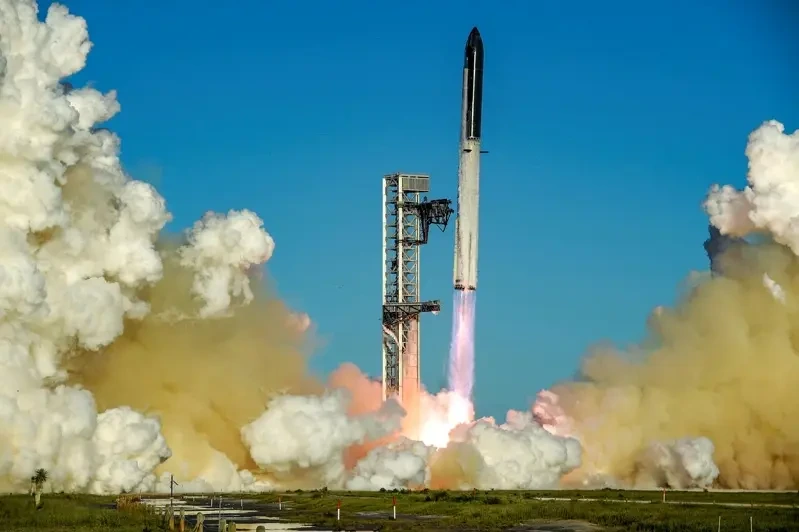
During its 15th test flight, SpaceX called off the recovery of the Starship booster due to technical issues; however, the Starship spacecraft successfully reached orbit. Should a recovery be achieved tomorrow, it would mark a historic breakthrough for fully reusable rockets.
SpaceX, the aerospace company founded by tech mogul Elon Musk, aborted the recovery attempt for the booster of Starship—the world’s largest and most powerful rocket—today. The company maintains, however, that capturing the Starship spacecraft itself remains a possibility; if successful, it would be an unprecedented achievement.
According to Agence France-Presse (AFP), the 124-meter-tall rocket roared into the sky from Starbase in southern Texas for its 15th test flight, but the mission—which was intended to be a milestone—encountered complications just minutes after liftoff.
Following the rocket’s liftoff and the separation of its two stages, a technical issue forced SpaceX to abandon plans to recover the “Super Heavy” booster, opting instead to have it splash down in the Gulf of Mexico.
The spacecraft itself has reached Earth’s orbit; SpaceX will attempt to recover it tomorrow, following a 22-hour space flight.
Successfully recovering both components of the Starship system would mark a major milestone in the space industry’s decades-long pursuit of a fully reusable rocket system. Such a system could drastically reduce mission costs and enable frequent launches.
SpaceX has previously succeeded in “catching” the booster three times—allowing the first stage to land vertically back at the launch site shortly after liftoff, where it was secured by the “chopstick” mechanical arms.
The entire space system is known as “Starship.” If SpaceX succeeds in catching the spacecraft, it will represent a breakthrough moment in the development of the Starship program. Certain versions of the vehicle are designed to carry internet satellites and data center infrastructure into orbit, while others are intended to transport humans to the Moon and Mars.
Clayton Swope, an aerospace expert at the Center for Strategic and International Studies (CSIS), stated that a fully reusable spacecraft is the “holy grail” that the space industry has long dreamed of achieving.
“No one has truly managed to do this yet,” he said. “People have been striving for this goal ever since the era of NASA’s Space Shuttle. However, the Space Shuttle ultimately proved to be a compromise, as many of its components could not be reused.”