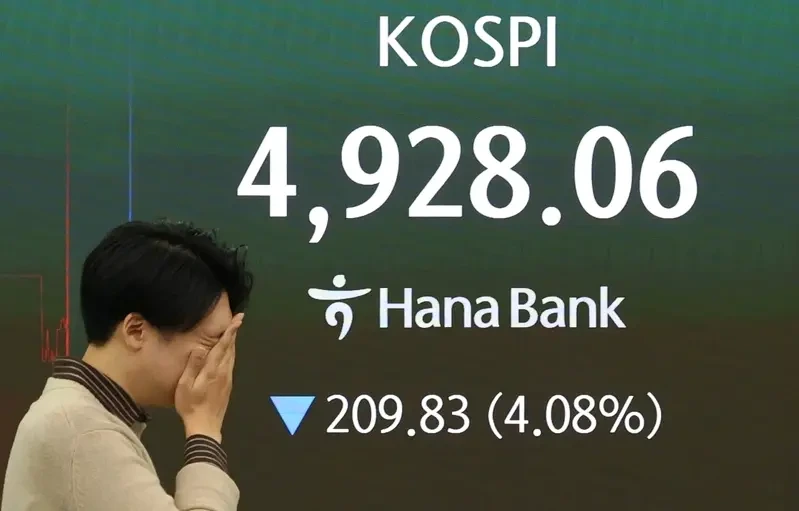
The Anthropic IPO failed to stabilize market sentiment, triggering a broad sell-off of AI and tech stocks across Asia. Investors are increasingly concerned about whether massive capital expenditures on AI will ever yield a return, while the market is also reeling from the departure of Jensen Huang, the prospect of tighter policy restrictions, and expectations of interest rate hikes.
Asian stock markets faced widespread selling pressure on Friday. Even the record-breaking IPO of Anthropic failed to restore confidence in the AI sector. Taiwan’s benchmark index plunged more than 5% during intraday trading, while South Korea’s KOSPI and Japan’s Nikkei 225 both saw declines of up to 4.8%. Tech stocks in mainland China and Hong Kong were also hit by a wave of selling. Analysts point out that the market’s concern has shifted beyond mere overvaluation; the core issue is whether the enormous investments poured into AI can actually generate a return. Meanwhile, the departure of Jensen Huang, the potential tightening of chip-related export controls, and expectations of U.S. interest rate hikes have prompted investors to accelerate their exit from risk assets.
Taiwan’s Taiex index saw its intraday losses widen to over 5%—a drop of more than 2,000 points—marking the steepest decline among major Asian markets. In South Korea, the KOSPI fell by as much as 4.8%, with Samsung Electronics and SK Hynix acting as the primary drags on the index. In Japan, the Nikkei 225 dropped by up to 4.8%, and the broader TOPIX index fell 3%. SoftBank Group, memory chipmaker Kioxia, and IC substrate manufacturer Ibiden all saw their shares plummet by more than 10% during morning trading.
The slump in tech stocks has spread to the broader market. The MSCI Asia Pacific Index, tracked by Bloomberg, fell 3%—its lowest level since April.
“There is a broad shift toward risk aversion in Asia today, with a widespread sell-off across stock markets,” said Tim Waterer, Chief Market Analyst at KCM Trade. “A confluence of concerns is weighing on sentiment, including lingering questions regarding the AI-driven rally. Traders are trimming their risk exposure and moving decisively toward safer assets.”
Markets in mainland China and Hong Kong were not spared. The STAR 50 Index opened more than 3% lower on Friday, leading a decline in Chinese equities alongside the ChiNext Index. Hong Kong’s Hang Seng Index fell by as much as 1.6%, bringing its decline from this year’s January closing high to nearly 20%, with NetEase acting as a major drag. The Hang Seng Tech Index dropped more than 3%, putting it on track for an eighth consecutive day of losses.
At the heart of this sell-off is the fact that the successful market debut of Anthropic has failed to resolve questions about profitability across the AI industry. Anthropic began trading on Thursday at $83 per share, climbed as high as $115.10, and ultimately closed up 17% at $97.17. However, the stock fell 4.7% in after-hours trading to $92.60—dropping below its intraday low from its first day of trading—which has further unsettled Asian markets.
Kyle Rodda, a senior financial market analyst at Capital.com, notes that while Anthropic’s IPO may have caused a stir, it is not enough to dispel investor concerns regarding the AI boom and the broader stock market outlook. He believes that as the AI frenzy cools—compounded by the possibility of further interest rate hikes from the Federal Reserve—market sentiment has become increasingly fragile, with pessimism potentially fueling further sell-offs.
Charu Chanana, chief investment strategist at Saxo Markets, points to a deeper issue: “Investors are beginning to wonder whether advanced AI is becoming a highly successful technology that is, at the same time, increasingly difficult to turn into a business capable of generating substantial returns.” She adds that reports of Apple developing its own AI agents have only deepened these concerns.
In other words, the rapid adoption of AI applications does not guarantee profitability for the companies investing heavily in them. The market is now increasingly focused on whether the massive capital—often raised through debt—that firms are pouring into chips and data centers will ultimately yield sufficient returns.
Jensen Huang’s sudden departure has made these questions even harder to resolve. Nvidia does more than just supply chips; it also supports its AI partners through investments and financing. The market is now left to reconsider how Nvidia will manage these relationships without its long-time leader at the helm, and who might eventually succeed him.
Wortel noted that tech stocks, which had previously carried overly high expectations, are now taking a heavy hit. Anthropic’s strong market debut failed to lift the broader AI sector, as market sentiment remains dominated by concerns over the sustainability of growth, potential supply chain bottlenecks, and the long-term outlook for Nvidia—particularly regarding its prospects following the eventual departure of CEO Jensen Huang.
Policy risks have also emerged. Following the U.S. Democratic Party’s significant gains in the midterm elections, opposition to the construction of data centers has gained traction, fueling investor fears of potential project delays. Furthermore, reports that TSMC and Samsung have suspended shipments of certain chips to clients in mainland China have sparked concerns that the U.S. may further tighten export controls on high-end semiconductors.
The Federal Reserve’s hawkish stance adds further pressure. Interest-rate futures indicate that the market has all but priced in a 25-basis-point (0.25 percentage point) rate hike in December. Wortel pointed out that the limited impact of Anthropic’s debut, combined with the Fed’s inclination toward continued monetary tightening, is dampening buying interest.
While Phillip Wool, head of investment management at Rayliant Global Advisors, remains bullish on AI, he cautions that simply buying a basket of AI hardware stocks is no longer a guaranteed path to profit; careful stock selection has become essential.
“Looking back at the boom-and-bust cycles of past tech crazes,” he said, “I am quite certain that if some of these risks begin to materialize, there could still be significant room for share prices to fall.”